Read From File Descriptor Until New Line
The C programming language provides many standard library functions for file input and output. These functions make up the bulk of the C standard library header <stdio.h>.[1] The functionality descends from a "portable I/O package" written past Mike Lesk at Bell Labs in the early 1970s,[2] and officially became part of the Unix operating system in Version seven.[iii]
The I/O functionality of C is fairly low-level by modern standards; C abstracts all file operations into operations on streams of bytes, which may be "input streams" or "output streams". Dissimilar some earlier programming languages, C has no straight support for random-access data files; to read from a tape in the center of a file, the programmer must create a stream, seek to the center of the file, and then read bytes in sequence from the stream.
The stream model of file I/O was popularized past Unix, which was developed meantime with the C programming language itself. The vast majority of modern operating systems have inherited streams from Unix, and many languages in the C programming linguistic communication family unit have inherited C's file I/O interface with few if any changes (for example, PHP).
Overview [edit]
This library uses what are chosen streams to operate with physical devices such as keyboards, printers, terminals or with any other type of files supported by the system. Streams are an abstraction to interact with these in a uniform way. All streams have like backdrop contained of the private characteristics of the physical media they are associated with.[4]
Functions [edit]
Virtually of the C file input/output functions are divers in <stdio.h> (or in the C++ header cstdio, which contains the standard C functionality simply in the std namespace).
| Byte character | Wide character | Clarification | |
|---|---|---|---|
| File access | fopen | Opens a file (with a non-Unicode filename on Windows and possible UTF-8 filename on Linux) | |
| freopen | Opens a dissimilar file with an existing stream | ||
| fflush | Synchronizes an output stream with the actual file | ||
| fclose | Closes a file | ||
| setbuf | Sets the buffer for a file stream | ||
| setvbuf | Sets the buffer and its size for a file stream | ||
| fwide | Switches a file stream between broad-character I/O and narrow-character I/O | ||
| Direct input/output | fread | Reads from a file | |
| fwrite | Writes to a file | ||
| Unformatted input/output | fgetc getc | fgetwc getwc | Reads a byte/wchar_t from a file stream |
| fgets | fgetws | Reads a byte/wchar_t line from a file stream | |
| fputc putc | fputwc putwc | Writes a byte/wchar_t to a file stream | |
| fputs | fputws | Writes a byte/wchar_t string to a file stream | |
| getchar | getwchar | Reads a byte/wchar_t from stdin | |
| | N/A | Reads a byte string from stdin until a newline or end of file is encountered (deprecated in C99, removed from C11) | |
| putchar | putwchar | Writes a byte/wchar_t to stdout | |
| puts | N/A | Writes a byte string to stdout | |
| ungetc | ungetwc | Puts a byte/wchar_t back into a file stream | |
| Formatted input/output | scanf fscanf sscanf | wscanf fwscanf swscanf | Reads formatted byte/wchar_t input from stdin, a file stream or a buffer |
| vscanf vfscanf vsscanf | vwscanf vfwscanf vswscanf | Reads formatted input byte/wchar_t from stdin, a file stream or a buffer using variable statement list | |
| printf fprintf sprintf snprintf | wprintf fwprintf swprintf | Prints formatted byte/wchar_t output to stdout, a file stream or a buffer | |
| vprintf vfprintf vsprintf vsnprintf | vwprintf vfwprintf vswprintf | Prints formatted byte/wchar_t output to stdout, a file stream, or a buffer using variable statement list | |
| perror | Due north/A | Writes a description of the current error to stderr | |
| File positioning | ftell ftello | Returns the electric current file position indicator | |
| fseek fseeko | Moves the file position indicator to a specific location in a file | ||
| fgetpos | Gets the file position indicator | ||
| fsetpos | Moves the file position indicator to a specific location in a file | ||
| rewind | Moves the file position indicator to the get-go in a file | ||
| Error treatment | clearerr | Clears errors | |
| feof | Checks for the end-of-file | ||
| ferror | Checks for a file error | ||
| Operations on files | remove | Erases a file | |
| rename | Renames a file | ||
| tmpfile | Returns a pointer to a temporary file | ||
| tmpnam | Returns a unique filename | ||
Constants [edit]
Constants defined in the <stdio.h> header include:
| Name | Notes |
|---|---|
| EOF | A negative integer of blazon int used to indicate end-of-file weather |
| BUFSIZ | An integer which is the size of the buffer used by the setbuf() function |
| FILENAME_MAX | The size of a char array which is large enough to store the name of any file that tin can be opened |
| FOPEN_MAX | The number of files that may be open up simultaneously; will be at least viii |
| _IOFBF | An abbreviation for "input/output fully buffered"; it is an integer which may be passed to the setvbuf() function to asking block buffered input and output for an open stream |
| _IOLBF | An abbreviation for "input/output line buffered"; it is an integer which may be passed to the setvbuf() function to request line buffered input and output for an open stream |
| _IONBF | An abbreviation for "input/output not buffered"; it is an integer which may be passed to the setvbuf() function to request unbuffered input and output for an open stream |
| L_tmpnam | The size of a char array which is large plenty to store a temporary filename generated by the tmpnam() role |
| Zip | A macro expanding to the null pointer constant; that is, a abiding representing a arrow value which is guaranteed non to exist a valid address of an object in memory |
| SEEK_CUR | An integer which may be passed to the fseek() function to request positioning relative to the current file position |
| SEEK_END | An integer which may be passed to the fseek() function to request positioning relative to the finish of the file |
| SEEK_SET | An integer which may exist passed to the fseek() function to request positioning relative to the beginning of the file |
| TMP_MAX | The maximum number of unique filenames generable by the tmpnam() function; volition be at to the lowest degree 25 |
Variables [edit]
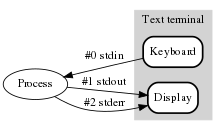
Variables defined in the <stdio.h> header include:
| Proper noun | Notes |
|---|---|
| stdin | A arrow to a FILE which refers to the standard input stream, ordinarily a keyboard. |
| stdout | A pointer to a FILE which refers to the standard output stream, usually a display terminal. |
| stderr | A pointer to a FILE which refers to the standard mistake stream, often a display last. |
Fellow member types [edit]
Data types defined in the <stdio.h> header include:
- FILE – also known as a file handle, this is an opaque type containing the information almost a file or text stream needed to perform input or output operations on it, including:
- platform-specific identifier of the associated I/O device, such as a file descriptor
- the buffer
- stream orientation indicator (unset, narrow, or wide)
- stream buffering land indicator (unbuffered, line buffered, fully buffered)
- I/O mode indicator (input stream, output stream, or update stream)
- binary/text mode indicator
- cease-of-file indicator
- fault indicator
- the electric current stream position and multibyte conversion state (an object of type mbstate_t)
- reentrant lock (required equally of C11)
- fpos_t – a not-array blazon capable of uniquely identifying the position of every byte in a file and every conversion land that tin can occur in all supported multibyte grapheme encodings
- size_t – an unsigned integer blazon which is the blazon of the result of the sizeof operator.
Extensions [edit]
The POSIX standard defines several extensions to stdio in its Base Definitions, amidst which are a readline function that allocates memory, the fileno and fdopen functions that institute the link betwixt FILE objects and file descriptors, and a group of functions for creating FILE objects that refer to in-retentiveness buffers.[5]
Case [edit]
The following C programme opens a binary file called myfile, reads five bytes from it, then closes the file.
#include <stdio.h> #include <stdlib.h> int chief ( void ) { char buffer [ v ]; FILE * fp = fopen ( "myfile" , "rb" ); if ( fp == NULL ) { perror ( "Failed to open file \" myfile \" " ); return EXIT_FAILURE ; } for ( int i = 0 ; i < 5 ; i ++ ) { int rc = getc ( fp ); if ( rc == EOF ) { fputs ( "An fault occurred while reading the file. \n " , stderr ); return EXIT_FAILURE ; } buffer [ i ] = rc ; } fclose ( fp ); printf ( "The bytes read were... %ten %x %x %x %ten \n " , buffer [ 0 ], buffer [ 1 ], buffer [ ii ], buffer [ 3 ], buffer [ 4 ]); return EXIT_SUCCESS ; } Alternatives to stdio [edit]
Several alternatives to stdio accept been developed. Among these is the C++ iostream library, part of the ISO C++ standard. ISO C++ however requires the stdio functionality.
Other alternatives include the SFIO[half-dozen] (A Safe/Fast I/O Library) library from AT&T Bell Laboratories. This library, introduced in 1991, aimed to avert inconsistencies, unsafe practices and inefficiencies in the design of stdio. Among its features is the possibility to insert callback functions into a stream to customize the handling of data read from or written to the stream.[7] It was released to the outside world in 1997, and the concluding release was 1 February 2005.[8]
See besides [edit]
- printf format string
- scanf format cord
References [edit]
- ^ ISO/IEC 9899:1999 specification (PDF). p. 274, § vii.19.
- ^ Kernighan, Brian; Pike, Rob (1984). The UNIX Programming Environment. Englewood Cliffs: Prentice Hall. p. 200.
- ^ McIlroy, M. D. (1987). A Research Unix reader: annotated excerpts from the Programmer's Manual, 1971–1986 (PDF) (Technical report). CSTR. Bell Labs. 139.
- ^ "(stdio.h) - C++ Reference".
- ^ – Base Definitions Reference, The Single UNIX Specification, Consequence 7 from The Open Group
- ^ "SFIO: A Safe/Fast I/O Library". Archived from the original on 11 February 2006. Retrieved xvi March 2021.
{{cite web}}: CS1 maint: bot: original URL condition unknown (link) - ^ Korn, David Thousand.; Vo, Kiem-Phong (1991). SFIO: Safe/Fast String/File IO. Proc. Summer USENIX Conf. CiteSeerX10.ane.1.51.6574.
- ^ Fowler, Glenn Southward.; Korn, David Yard.; Vo, Kiem-Phong (2000). Extended Formatting with Sfio. Proc. Summertime USENIX Conf.
External links [edit]
-
 Media related to C file input/output at Wikimedia Commons
Source: https://en.wikipedia.org/wiki/C_file_input/output
0 Response to "Read From File Descriptor Until New Line"
Post a Comment